
In an ideal scenario—a bare steel pipe suspended in mid-air—an ultrasonic guided wave propagates through the pipe wall as if it were a tuning fork. Because the surrounding air is a low-density medium with negligible shear strength, it creates a massive acoustic impedance mismatch; the air cannot efficiently support the transfer of mechanical energy from the steel. This results in a "perfect" or traction-free boundary condition where ultrasonic energy remains confined within the steel waveguide, allowing for minimal attenuation and theoretical inspection ranges of up to 100 meters.
However, once a pipe is coated, buried, or submerged, the boundary conditions shift from traction-free to loaded. The pipe becomes mechanically coupled to an external medium, initiating three primary energy dissipation mechanisms. While these environmental factors are not physical "features" and do not produce discrete echoes, they act as parasitic drains that significantly limit the A-scan length and the overall effective range of the Guided Wave Inspection.
This Application Note identifies the most common attenuators encountered in the field and establishes expected inspection ranges for these specific conditions. As the provided ranges are estimations, a test acquisition is mandatory to determine the definitive inspection range for each unique field case.
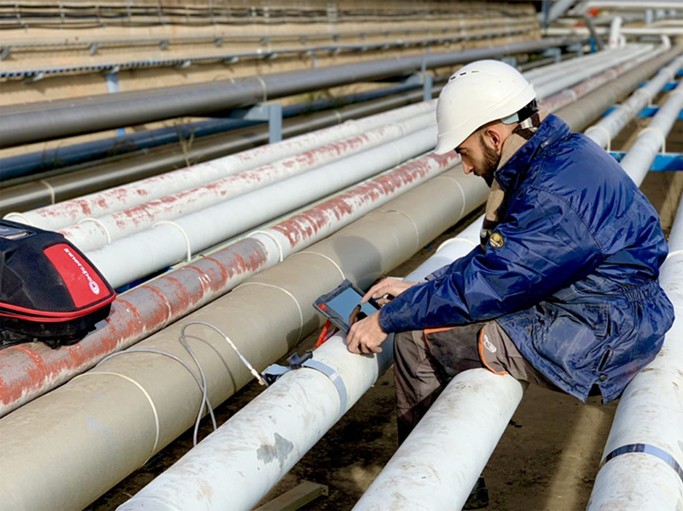
When a pipeline is encased in a dense, bulk medium—such as saturated soil, compacted clay, or water—the pipe wall ceases to be an isolated waveguide. As the guided wave propagates, the pipe wall effectively becomes a transducer interface.
The high-frequency mechanical oscillations of the steel excite the surrounding medium. If the phase velocity of the guided wave mode exceeds the longitudinal or shear wave velocity of the surrounding material, energy leaks across the interface. Consequently, a portion of the wave packet's energy is converted into bulk waves (longitudinal and shear) that radiate into the infinite medium of the soil or water, rather than remaining confined to the steel.
Unlike soil, which facilitates energy leakage into the surrounding environment, viscoelastic coatings act as a mechanical sponge. These materials absorb ultrasonic vibrations and convert them into heat through internal molecular friction.
The level of attenuation is directly proportional to bond integrity: the more adhered the coating is to the pipe surface, the greater the damping effect on the signal. Consequently, high-viscosity coatings "choke" the wave energy much faster than dry or loosely bonded materials.
While external coatings and soil are the primary "energy thieves," the medium inside the pipe also impacts the inspection range. This interaction is governed by the acoustic impedance mismatch between the steel wall and the internal product.
Internal contents are critical attenuators that determine the effective A-scan length. The impact on inspection range is directly proportional to the viscosity of the product; as viscosity increases, so does the level of attenuation. Heavier, high-viscosity products "grip" the interior pipe wall, creating a parasitic drain that converts ultrasonic energy into shear-related heat loss.
It is important to note that although water should only cause minimal attenuation, water-filled pipes are normally impossible to inspect, or the range is significantly reduced to under 10 m. The main hypotheses relate to micro-corrosion and/or solid sediment (caused by poor water quality). New pipelines containing water, or filtered water-filled pipes, are suitable for evaluation.
