
LRUT FOCUS is a long-range ultrasonic testing technique capable of scanning up to 200 m (100 m on each side of the sensor location). Utilizing circumferential focusing, it enables the detection and localization of defects around the pipe's circumference across the entire inspected length. The technique delivers a circumferential resolution ranging from 5° to 25°, depending on the pipe diameter.
Pulsing with the axisymmetric ribbon and receiving with the scanner in small steps permits achieving the maximum resolution possible for each pipe diameter. As a reference, a standard 9-inch pipe allows for obtaining up to 14 flexural modes, which equates to a 25° resolution—significantly surpassing the 45° resolution of conventional piezo collars.
The system utilizes a patented magnetostrictive (MS) strip scanning methodology to transmit shear horizontal waves from the scanners to the substrate. This scanning approach increases the signal-to-noise ratio (SNR) by more than 20 dB compared to piezoelectric collars, while providing a smaller dead zone and better mode selectivity.
By using a separate transmitter and receiver, efficiency is increased and the dead zone is reduced. A frequency range from 32 kHz to 128 kHz, combined with a higher SNR, provides superior sensitivity and flaw discrimination compared to conventional piezo collars. LRUT FOCUS allows for the detection of pits and defects as small as 2 to 3 mm in diameter, representing less than 1% of the cross-sectional area (CSA).
The Coupling and Transmission Balancing (CTB) technique integrated into the application maximizes the probability of detection (PoD) by correcting imbalances and ensuring uniform inspection coverage, regardless of transducer or coupling imperfections.
Results are presented in various customizable views, including an unrolled pipe B-scan providing 0 to 360-degree data, and an A-scan display of specific angular locations that allows for seamless user navigation. Additionally, the software features a polar plot for follow-up priority definition and a comprehensive component map. The automatic reporting functionality enables the effortless creation and sharing of customized reports containing both inspection results and test configurations.
The LRUT FOCUS technique is available on the VOLTA 2 inspection platform—a single, cost-effective, and flexible system designed to cover all your guided wave inspection needs. VOLTA can be utilized to perform any EMAT technique, including thickness measurement, weld inspection, and both medium-range and long-range guided wave techniques.
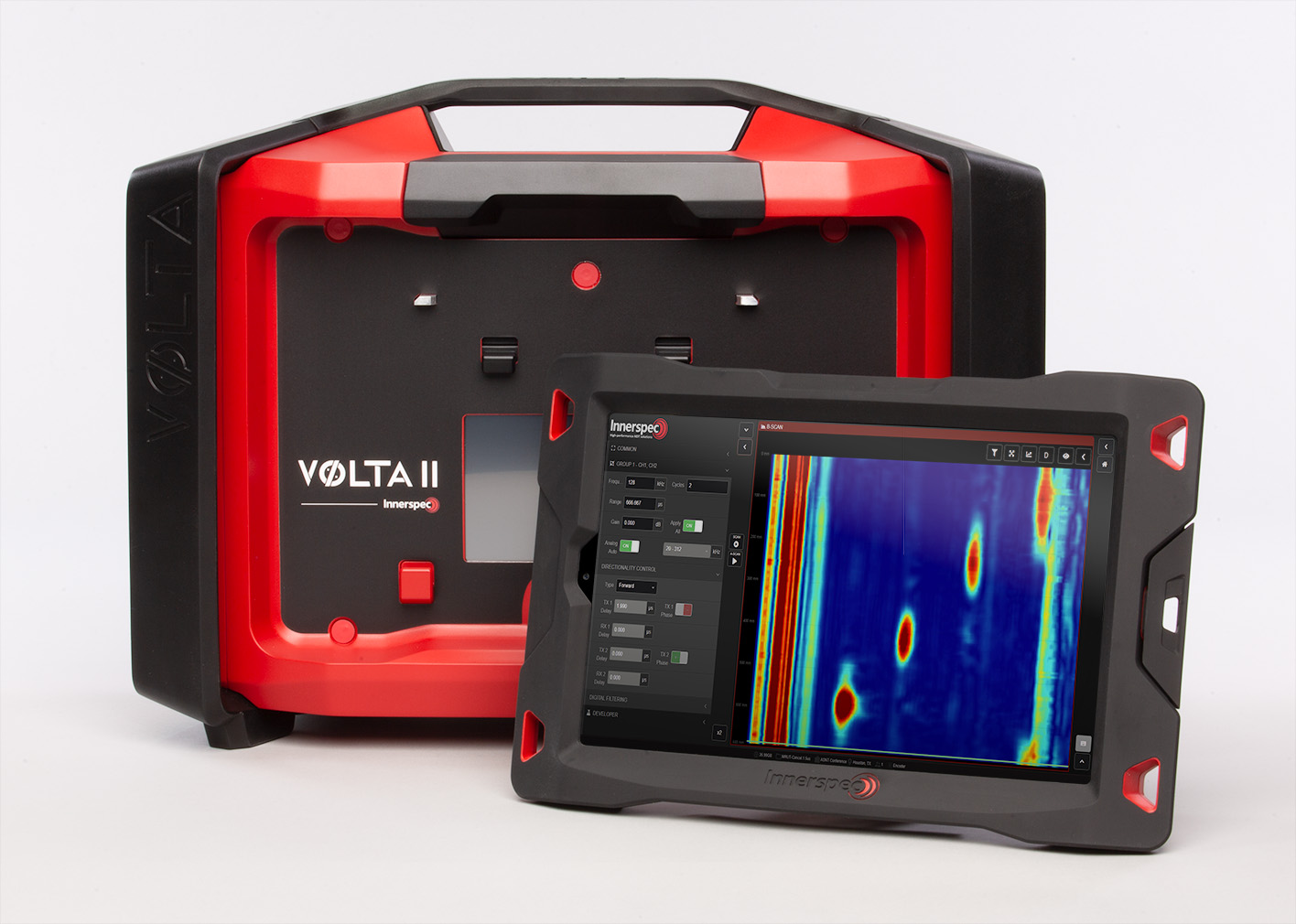
VOLTA 2 is a high-voltage, two-channel portable ultrasonic instrument designed for use with electromagnetic acoustic transducers (EMATs). It incorporates a proprietary pulser architecture capable of generating tone bursts from 1 to 10 cycles with output amplitudes up to 1,000 Vpp. The pulser design supports the high excitation energy requirements typical of EMAT-based inspections while maintaining a compact, field-deployable form factor.
A magnetostrictive strip must be installed for the ribbon coil, and two additional strips need to be applied side-by-side to the pipe, approximately 6 inches (152 mm) in front of the ribbon, to be used with the scanner. The axisymmetric data is acquired using the ribbon coil in a pulse-echo configuration within SCAN mode and saved as ASCAN-00x. A preliminary scan with the transmit/receive ribbon determines the presence of discontinuities, while additional scans at different angles permit correcting for coupling or transmission imbalances. Finally, Coupling and Transmission Balance (CTB) is applied to generate the final A-scan.
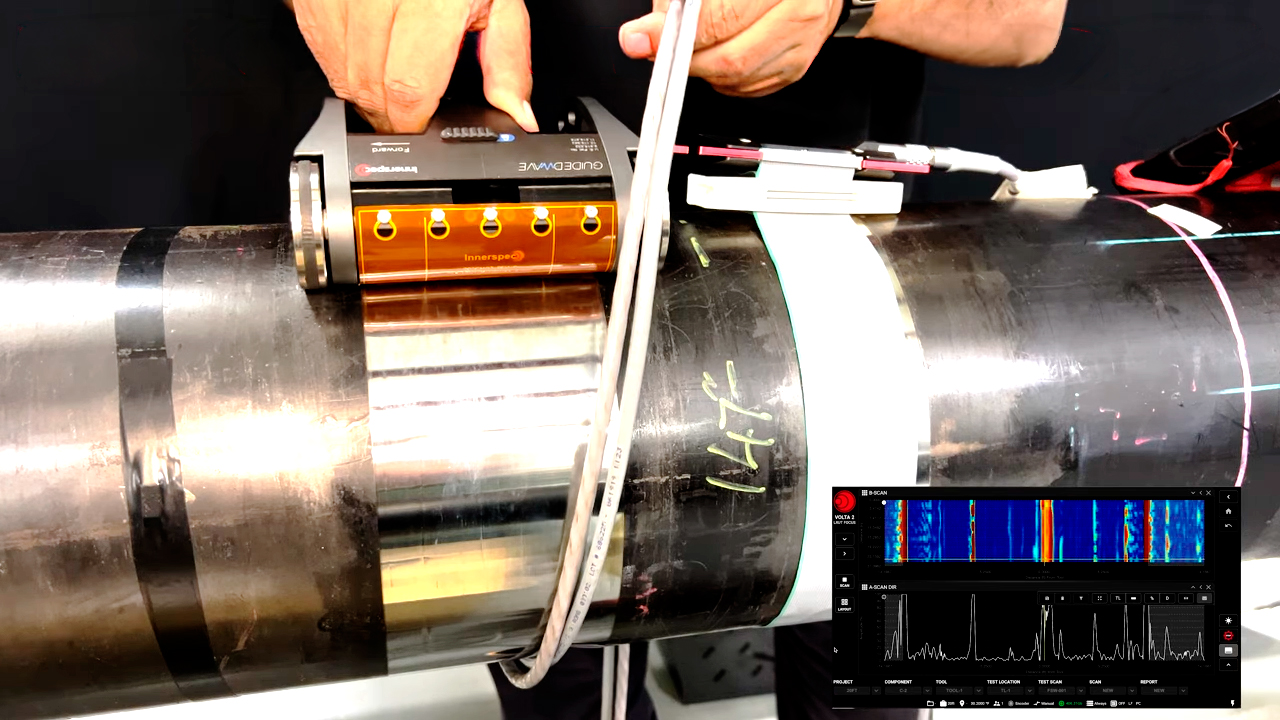
The EMAT coil is mounted on a scanner that moves circumferentially around the pipe in front of the ribbon at a fixed distance, collecting data in a pitch-catch configuration. Once the data is acquired by scanning the EMAT receiver around the pipe circumference, the file is saved and a post-processing synthetic focusing algorithm is applied. The focused data is then saved as Focus-SC-00x. Each LRUT FOCUS dataset is composed of one axisymmetric A-scan (ASCAN-00x), an unfocused scan(SC-00x), and a focused scan (FOCUS SC-00x).
The Synthetic Focusing algorithm is a complex, back-propagation signal reconstruction method. It processes the measured wave field reflected to the collar and propagates all mode components—accounting for their known amplitude, phase, frequency, and arrival time—back to any position along the pipe to evaluate constructive regeneration. This approach enables the system to map the exact origin of the waves, effectively imaging the flaw or any other structural reflector.
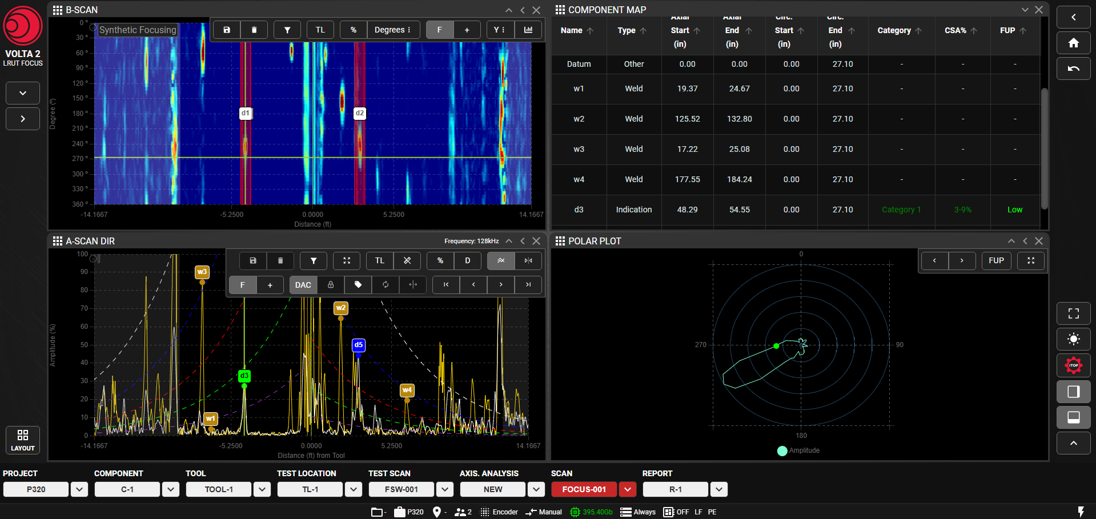
The final output is an unrolled pipe B-scan providing comprehensive 0 to 360-degree data. Placing a horizontal cursor on any location or indication within the focused B-scan generates the corresponding A-scan for that specific angular position. Available displays also include a component map that lists the identified indications alongside their calculated values, such as categorization, axial location, estimated CSA%, and FUP.
The Follow-Up Priority (FUP) feature provides a polar plot of the defect signal from the synthetically focused scan, displaying the distribution of reflected signals and the angular width of the flaw. The system computes a directionality value, "D," from the polar plot's directionality distribution, alongside a severity category value, "C." The product of C and D then delivers the final Follow-Up Priority rating to guide operators in their maintenance scheduling.
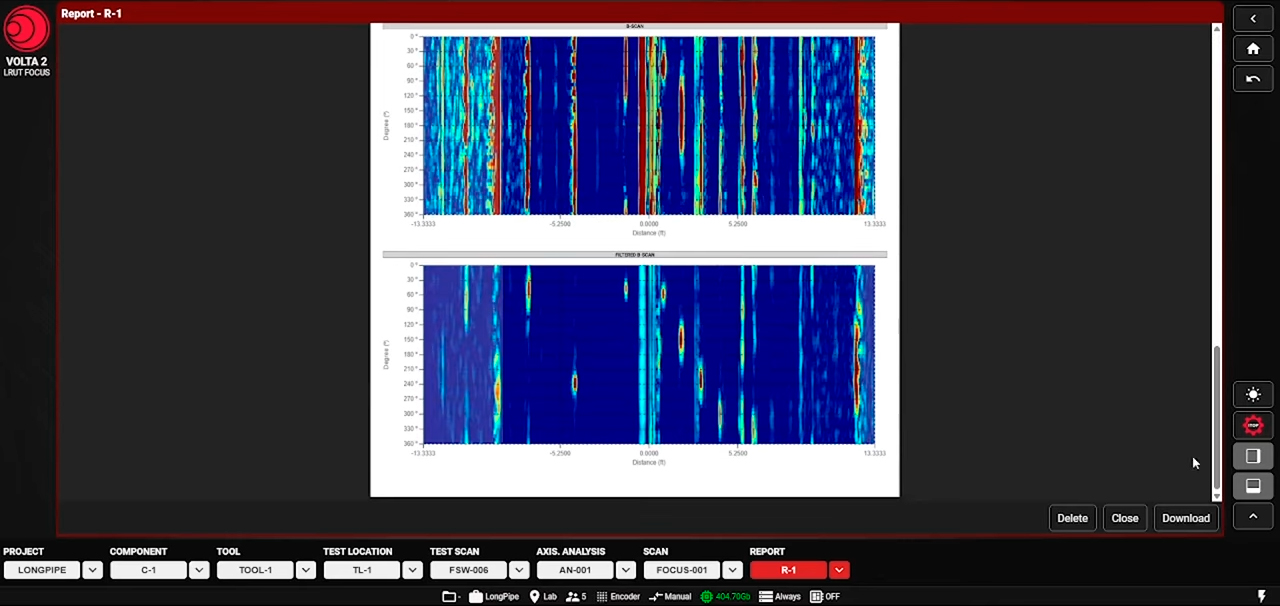
The automatic, built-in reporting functionality enables fast and seamless generation of customizable reports. Operators can easily select the specific datasets to include, such as inspection setups, component data, and scan results. Once generated, the report scan be downloaded directly to the device and shared in PDF format.
